
Morris County Previous Residents by Era
Different sources cover different parts of a Morris address history. Use the County Tax Board to identify the current parcel and a selected tax year. Use the County Clerk index for recorded property leads from its stated 1960 online boundary. For deeper work, move to the Records Vault, library directories, maps, census material, and newspaper indexes. A past resident can appear in an address directory even when a deed names a different title holder, so the columns below separate ownership evidence from household evidence.
| Source | Years it covers | Where held | What it shows |
|---|---|---|---|
| County Clerk online property index | Stated online back to 1960 | County Clerk web search | Recorded property-party lead |
| Clerk books, microfilm, and Vault | Late 1700s onward | Records Vault and request route | Older deeds, mortgages, liens, maps, and related records |
| Morris County Tax Board | Selected tax years available in the portal | Online search and municipal assessment offices | Owner and parcel context by tax year |
| Morristown directories | 1885 to 1982 reported | North Jersey History & Genealogy Center | Address, household, and business clues |
| Morris County directories | 1883 to 1909 named titles; other holdings vary | Libraries and State Library inventory | County or community name and address clues |
| New Jersey and federal census material | NJ 1855 to 1915; federal through 1950 released | Library finding aids and approved archive or database routes | Household and location snapshots |
| Newspapers and obituary indexes | Chronicle 1877 to 1915; other local runs vary | Library, microfilm, and Chronicling America | Death, marriage, move, civic, and property-event leads |
Begin with the era that is known. A recent transfer usually starts with the parcel and Clerk index. An address from the early twentieth century often needs a directory sequence, the 1909 Sanborn map, and a census or newspaper check. Every record should retain its title, source URL or repository, year, page or book and page, and the confidence that its date supports.
Morris County Previous Residents Start With a Parcel
Before searching names, run the address through the Morris County Tax Board search. Property mode requires a tax year, district, and street name, with house number optional. The result can supply the block, lot, qualifier, situs location, owner, mailing information, and tax-year context. Save the municipality and district too. Morris County postal labels can cross municipal boundaries, so a Morristown mailing line does not by itself select the correct tax office or legal property record.
The tax result is a parcel anchor, not a finding of who occupied a property. It points the search toward the recorded legal description and later maps. The Morris GIS public apps can help visualize the same identifiers and recover map context. Its parcel polygons are planning representations, not legal surveys. Use the official tax map, recorded map, or instrument whenever an exact line or relationship matters.
Note: Preserve the tax year with each result because a later owner line may not explain an earlier address.
Morris County Previous Residents and Prior Lots
A current block and lot can conceal a prior parcel identity. The Tax Board prior-block mode accepts a tax year, district, prior block, and prior lot, with an optional prior qualifier. It is especially useful after a subdivision, merger, or parcel renumbering. Compare multiple tax years, preserve both identifiers, and use the older one in the deed and map search. This is Morris's practical parcel-fossil method: the older legal identity can survive even when the convenient street label has changed.
Do not treat a similar street name as proof of continuity. The research did not identify a countywide street-renumbering project with a definitive year-by-year bridge. For an apparent break, consult a municipal historic survey, recorded subdivision map, historical GIS material, and the municipal clerk before joining an old and a new number.
Trace Morris County Previous Residents Through Deeds
The County Clerk holds the title layer. The Morris County Online Property Records Search states that online records go back to 1960. When the Tax Board produces a current owner and legal identity, search the owner as a party and identify the purchase deed. The seller on that instrument becomes the next name to search as a grantee for the earlier purchase. Search both party roles, the date range, municipality, book and page, and instrument details when available. A name may appear under initials, a different spelling, or a legal capacity.
- Record the present parcel's municipality, tax year, block, lot, qualifier, and legal-description lead from the Tax Board or official tax map.
- Find the current owner’s acquisition in the Clerk party or instrument index and record the instrument date, parties, book and page, and legal description.
- Take the seller from that deed and search that person as a grantee to locate the prior acquisition of the same legal parcel.
- Repeat the backward search, testing spelling variants and comparing the legal description at every transfer.
- When the online index reaches its 1960 boundary, move to the Records Vault books, microfilm, digital images, or copy-request process.
- Grantor / grantee
- The grantor transfers an interest in the instrument; the grantee receives that interest.
- Chain of title
- A dated sequence of recorded transfers for the same legal parcel, checked link by link.
- Legal description
- The recorded land identity. It is more stable than a street label when parcels or numbers have changed.
- Criss-cross directory
- An address-first directory that can connect a specific edition year to a listed name or business.
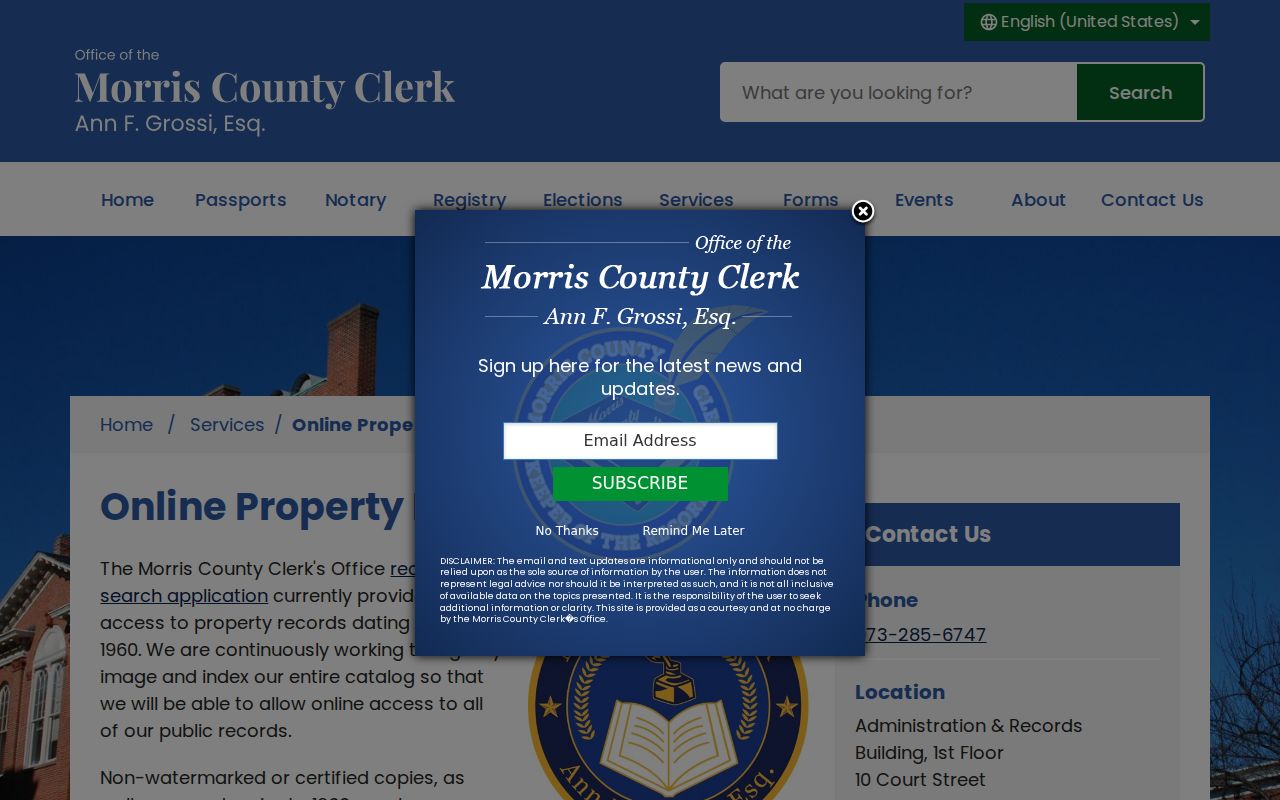
The official Clerk property-search screen in this image is the starting point for a Morris address-history deed trail.
A recorded deed proves a title event, not a household. Compare it with directories, census material, newspaper notices, or a tax record for the relevant year before describing who lived at the address.
Morris County Previous Residents Before 1960
When a transfer predates the web index, the Records Vault is the Clerk route for books, microfilm, and digital images from the late 1700s onward. The published mail process asks for a record description and book and page when known, return address, and payment. The research lists $1 per page plus $10 certification for a certified copy, $2 per page for a non-certified copy, and $1 postage without a self-addressed stamped envelope. That route is more reliable than guessing at a past resident from a surname match.
For deeper context, the Morris County Archives at the County Library publishes holdings in road returns from 1741 to 1915, building contracts from 1853 to 1972, mechanics' liens from 1851 to 1930, estate files from 1793 to 1962, court records, and licenses. Appointments are required. Road returns can place landowners along a route before modern street numbering, while construction and lien records can supply a project date or named party. Neither source automatically names an occupant.
Morris County Past Residents in Directory Sequences
Past residents are most often found by pairing a dated address directory with other records. The North Jersey History & Genealogy Center reports Morristown directories from 1885 to 1982 and Morris County directories from 1897 to 1909. The State Library inventory identifies countywide Boyd, Vogt Bros., and Richmond titles from 1883 to 1909, plus many Morristown editions. Search the street index and the surname pages, test initials and abbreviated given names, and note whether the entry appears to be a household or business reference. The collections and their access routes are detailed on the Morris city directories page.
Build the household sequence as a dated flow: address in one directory edition, then the prior and next available editions, then the census closest to each interval. The Morristown library finding aids include New Jersey state census material from 1855 through 1915, mortality schedules for 1850 through 1880, and census microfilm; federal decennial images are released through 1950 under the 72-year rule. A census is a snapshot, so check the municipality and boundary for that census year.
- Write down the directory title, publication year, page, street spelling, and house number.
- Search the same address in the preceding and following available editions, then compare names, spouse clues, occupation labels, and address wording.
- Pair the edition range with the available state or federal census year and preserve the enumeration place.
- Test the sequence against a deed, tax record, obituary, or newspaper notice before assigning a household history.
Note: Publication can lag compilation, so a directory entry supports a dated association, not an exact move-in or move-out date.
Morris County Previous Residents on 1909 Maps
The Library of Congress Morristown Sanborn set gives a 1909 built-environment layer with 44 sheets, including Whippany, Morris Plains, and Mount Tabor. Use the sheet date and building footprint to check whether a structure, addition, or street context aligns with the directory and deed dates. A Sanborn map shows use and physical context, not the identity of an occupant. Treat it as one independent layer in a Morris address-history timeline.
The Morristown & Morris Township Library house-history guidance also points to historic maps, surveys, land records, abstracts, deeds, mortgages, and five decades of Morristown building and construction blueprints from 1909 to 1959. More than 10,000 historic maps, land records, and early surveys are reported, but only a small portion is online. Onsite registration and reading-room research are normal; remote research is limited and fee-based with no guarantee.
Morris County Previous Residents in Newspapers
Newspapers can add a date or event to an address trail, but they should lead to a record rather than replace one. The North Jersey center reports newspaper holdings from 1779 to the present, Daily Record and Morristown Record microfilm from 1900 onward, and obituary indexes for the Daily Record from 1935 to 2016 and Morristown from 1818 to 1941. Chronicling America provides the Morris County Chronicle from 1877 to 1915, with its strongest coverage from October 1897 through December 1914. Capture the title, issue date, page, and repository for every notice.
Some early local newspaper material was affected by the 1914 Morristown library fire. A missing local original does not mean the event was never reported. Check surviving microfilm, the State Library inventory, Chronicling America, and neighboring repositories. For an estate endpoint, compare the notice with the appropriate Surrogate, Clerk, Archives, or court source instead of treating social wording as a certified identity record.
Morris County Previous Residents and Address Privacy
Historical curiosity has limits. New Jersey's Address Confidentiality Program provides a designated substitute address for eligible people, and Daniel's Law protects certain covered people’s home addresses and unpublished telephone numbers. Old directories, deeds, and newspapers may remain historical records, but they do not authorize attempts to locate a protected present address. If a record appears sealed, redacted, or restricted, use the custodian's stated process and do not reconstruct the missing detail from other sources.
Lawful use. Morris address-history research supports house history, family history, and personal curiosity. Do not use an address trail to stalk, harass, intimidate, or harm a living person.
The strongest past-resident conclusion is modest and reproducible: state the source, its date, the address or legal parcel as printed, and what the record actually establishes. Keep ownership, address association, and household evidence separate.